This a summary of a workshop
presented at the ICPE-GIREP International Conference Hands-on Experiments in Physics
Education in Duisburg, Germany, August 28, 1998.
PHYSICS AND TOYS - PHYSICS FUN FOR EVERYONE
Raymond C. Turner, Department of Physics and
Astronomy, Clemson University, Clemson, South Carolina 29634-1911 (USA)
Beverley A. P. Taylor, Department of Physics,
Miami University, 1601 Peck Boulevard, Hamilton, Ohio 45011, (USA)
Introduction
Physics is an exciting science and it can be made fun through the use of ordinary
children's toys. This hands-on workshop was designed for teachers at all levels in search
of fun physics demonstrations, lab experiments, and interactive materials for their
students. More than 50 toys were demonstrated, and the physical principles related to
these toys discussed. Everyone had the opportunity to participate in both qualitative and
quantitative investigations using the toys. The workshop leaders have found that toys can
be utilized at all grade levels from kindergarten through college by varying the
sophistication of the analysis. The aim of the workshop was to provide participants with
information that would assist them in developing toy-based lessons and finding
demonstrations of physical principles for their students.
In this paper we describe many of the toys which were demonstrated, and give
indications of the physical principles which might be discussed using these toys. More
detailed discussion is given for only a small number of the toys.
Section 1. Whistling Balloon Helicopter
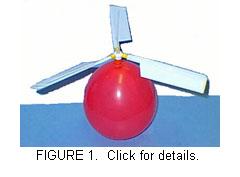 A picture of the Whistling Balloon Helicopter is shown in Figure 1. To
operate the toy, you first inflate the balloon, then attach it to the helicopter blades,
and finally release the toy. The helicopter blades will rotate, causing the helicopter to
rise into the air, while emitting a loud whistle.
A picture of the Whistling Balloon Helicopter is shown in Figure 1. To
operate the toy, you first inflate the balloon, then attach it to the helicopter blades,
and finally release the toy. The helicopter blades will rotate, causing the helicopter to
rise into the air, while emitting a loud whistle.
The workshop participants first tried the toy and then were then asked to cite some
physical principles that were related to the toy's operation. Examples given included
Newton's Second and Third Laws, kinetic and potential energies, angular momentum and
torque, pressure, and Bernoulli's principle. While we stopped the discussion after about
15 different physical concepts were given, more than 30 can easily be listed. For a toy
that costs less than US $1, there is probably more physics for your money here than in any
other device that we have.
Section 2. Balancing and Bouncing Toys
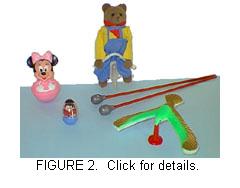 Several balancing toys are shown in Figure 2. These include a Weeble®
(Weebles wobble but they don't fall down), Minnie Mouse®, a balancing bird,
and Ernest® the balancing bear. (1) The toys can be used to discuss
equilibrium, center of mass, and torque among other things. Minnie and the Weeble
obviously contain a weight in the bottom, so that when they are tipped, the weight is
raised and the gravitational force (torque) causes them to return to the upright position.
The behavior of the balancing bird is not quite as obvious. In this case, it is the weight
concentrated in the wing tips that causes its center of mass to be below its balance
point, resulting in stable equilibrium. Ernest doesn't balance at all when he is as shown
in the figure. But when rods with weights on them are inserted in the handlebars of his
bike, he balances very well, and can ride his unicycle along a string stretched across the
room.
Several balancing toys are shown in Figure 2. These include a Weeble®
(Weebles wobble but they don't fall down), Minnie Mouse®, a balancing bird,
and Ernest® the balancing bear. (1) The toys can be used to discuss
equilibrium, center of mass, and torque among other things. Minnie and the Weeble
obviously contain a weight in the bottom, so that when they are tipped, the weight is
raised and the gravitational force (torque) causes them to return to the upright position.
The behavior of the balancing bird is not quite as obvious. In this case, it is the weight
concentrated in the wing tips that causes its center of mass to be below its balance
point, resulting in stable equilibrium. Ernest doesn't balance at all when he is as shown
in the figure. But when rods with weights on them are inserted in the handlebars of his
bike, he balances very well, and can ride his unicycle along a string stretched across the
room.
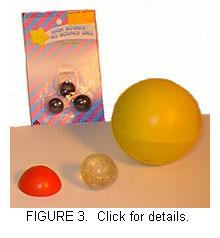 In Figure 3 are shown several bouncing toys which demonstrate a variety
of physical phenomena. The High Bounce/No Bounce Balls (happy/sad balls) are neoprene
rubber balls which feel very much the same when squeezed, but behave very differently when
bounced. One ball bounces quite high (like a super ball) while the other doesn't bounce at
all (like a ball of clay). These balls can be used to discuss the properties of materials
as well as to discuss different types of collisions. Super balls can be used to discuss
the energy lost when they are dropped and allowed to bounce, and this discussion can be
extended by dropping them onto a variety of different surfaces. A Hopper-Popper®
is a toy that is similar to about one-third of a hollow rubber ball. When this is turned
inside out, and dropped from a height of about one meter, it will "bounce" to a
height of about one and one-half meters. This certainly attracts the students' attention,
and can then be used to discuss conservation of energy and the different types of
mechanical energy. The Krazy Roll-A-Ball® has an off-center weight embedded in
it, so that its rotational motion is not about the geometrical center of the ball. When it
is tossed into the air with a rotational motion, it appears to wobble in a crazy way (but
it is just rotating about its center of mass). Also, when it is rolled along a table, its
motion is very erratic as its center of mass changes its position up-or-down, or sideways.
In Figure 3 are shown several bouncing toys which demonstrate a variety
of physical phenomena. The High Bounce/No Bounce Balls (happy/sad balls) are neoprene
rubber balls which feel very much the same when squeezed, but behave very differently when
bounced. One ball bounces quite high (like a super ball) while the other doesn't bounce at
all (like a ball of clay). These balls can be used to discuss the properties of materials
as well as to discuss different types of collisions. Super balls can be used to discuss
the energy lost when they are dropped and allowed to bounce, and this discussion can be
extended by dropping them onto a variety of different surfaces. A Hopper-Popper®
is a toy that is similar to about one-third of a hollow rubber ball. When this is turned
inside out, and dropped from a height of about one meter, it will "bounce" to a
height of about one and one-half meters. This certainly attracts the students' attention,
and can then be used to discuss conservation of energy and the different types of
mechanical energy. The Krazy Roll-A-Ball® has an off-center weight embedded in
it, so that its rotational motion is not about the geometrical center of the ball. When it
is tossed into the air with a rotational motion, it appears to wobble in a crazy way (but
it is just rotating about its center of mass). Also, when it is rolled along a table, its
motion is very erratic as its center of mass changes its position up-or-down, or sideways.
Section 3. Stored Energy Toys
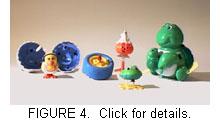 Several toys, which
use springs or rubber bands to store energy, are shown in Figure 4. These toys can
generate lively discussions about potential energy and energy transformations. The pumpkin
spring-up and Mother-N-Baby™ are nice examples of work being done (a force
clearly moves), energy being stored as elastic potential energy, then later being changed
into kinetic energy. The Eggscaper and crazy wheel, both of which are wind-up toys, as
well as the flip frog, also lend themselves to the discussion of other physics concepts.
The egg of the Eggscaper explodes to reveal the hopping chick conserving linear momentum
in the process. The crazy wheel has an off-center weight in it, so it moves in unexpected
ways. The flip frog is an excellent example of Newton's third law. A spring pulls up on
the back of its feet, forcing its toes down against the table and it flips over backwards.
Further information about these toys can be found in "Exploring Energy with Toys:
Complete Lessons for Grades 4-8." (2)
Several toys, which
use springs or rubber bands to store energy, are shown in Figure 4. These toys can
generate lively discussions about potential energy and energy transformations. The pumpkin
spring-up and Mother-N-Baby™ are nice examples of work being done (a force
clearly moves), energy being stored as elastic potential energy, then later being changed
into kinetic energy. The Eggscaper and crazy wheel, both of which are wind-up toys, as
well as the flip frog, also lend themselves to the discussion of other physics concepts.
The egg of the Eggscaper explodes to reveal the hopping chick conserving linear momentum
in the process. The crazy wheel has an off-center weight in it, so it moves in unexpected
ways. The flip frog is an excellent example of Newton's third law. A spring pulls up on
the back of its feet, forcing its toes down against the table and it flips over backwards.
Further information about these toys can be found in "Exploring Energy with Toys:
Complete Lessons for Grades 4-8." (2)
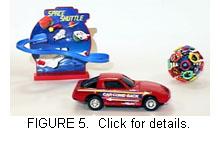 Three additional energy
transformation toys are shown in Figure 5. The Shuttle-Go-Round runs on batteries;
therefore, chemical and electrical energy can be introduced into the discussion. Toys that
roll back to you have been common folk toys over the years, but the Car Come-Back takes
the common toy to another level. Not only does it come back to you, but it actually turns
around in the process. Figuring out the mechanism which causes it to turn can be a good
learning experience for students. Often in discussing the energy transformations which
occur when a ball bounces, one tells students to think of a ball as being made of tiny
springs. The Ka-bong Ball is a nice visual aid in that it really is made out of springs.
Three additional energy
transformation toys are shown in Figure 5. The Shuttle-Go-Round runs on batteries;
therefore, chemical and electrical energy can be introduced into the discussion. Toys that
roll back to you have been common folk toys over the years, but the Car Come-Back takes
the common toy to another level. Not only does it come back to you, but it actually turns
around in the process. Figuring out the mechanism which causes it to turn can be a good
learning experience for students. Often in discussing the energy transformations which
occur when a ball bounces, one tells students to think of a ball as being made of tiny
springs. The Ka-bong Ball is a nice visual aid in that it really is made out of springs.
Section 4. Pressure Toys
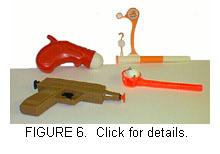 A variety of toys can be used to illustrate different aspects of
pressure. Shown in Figure 6 are a popgun, a dart gun, the Mystery Blow Pipe™, and The
Hang Up. The popgun is a hollow rubber gun with a ping-pong ball inserted in the end. When
the gun is squeezed, its volume decreases, its pressure increases, and the ball shoots
out. The dart gun shoots a soft rubber dart which will stick to a smooth surface. This
behavior can then be used to discuss atmospheric pressure. In addition, the dart gun can
be used to discuss projectile motion, both with and without air resistance. The ball in
the Mystery Blow Pipe will rise up when air is blown into the pipe, and it will remain
over the pipe as the pipe is moved. The ball's reasonably stable position can be
understood by applying Bernoulli's Principle. The Hang Up is a similar toy which has the
added challenge of hooking the ball in the loop.
A variety of toys can be used to illustrate different aspects of
pressure. Shown in Figure 6 are a popgun, a dart gun, the Mystery Blow Pipe™, and The
Hang Up. The popgun is a hollow rubber gun with a ping-pong ball inserted in the end. When
the gun is squeezed, its volume decreases, its pressure increases, and the ball shoots
out. The dart gun shoots a soft rubber dart which will stick to a smooth surface. This
behavior can then be used to discuss atmospheric pressure. In addition, the dart gun can
be used to discuss projectile motion, both with and without air resistance. The ball in
the Mystery Blow Pipe will rise up when air is blown into the pipe, and it will remain
over the pipe as the pipe is moved. The ball's reasonably stable position can be
understood by applying Bernoulli's Principle. The Hang Up is a similar toy which has the
added challenge of hooking the ball in the loop.
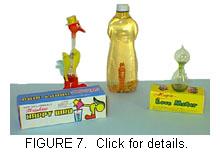 The toys in Figure 7 include a tiger Cartesian diver, a Happy Bird, and
a Magic Love Meter. (3) The tiger will float in the bottle of water until the bottle is
squeezed, increasing the pressure. Additional water then enters a small hole in the tiger,
and it sinks due to its increased density. When the head of the Happy Bird is moistened
with water, the bird will repeatedly tip over and appear to be drinking from a cup placed
in front of it. This operation is due to the evaporating water which cools the bird's
head, reducing the pressure of the gas inside, so that the liquid inside the bird rises,
causing it to tip and appear to be drinking. The Magic Love Meter is a hand boiler. When
the gas in the lower portion of the glass bulb is warmed by holding it in your hand, the
liquid rises into the upper glass ball and the vapor bubbles vigorously through the liquid
so that it appears to be boiling.
The toys in Figure 7 include a tiger Cartesian diver, a Happy Bird, and
a Magic Love Meter. (3) The tiger will float in the bottle of water until the bottle is
squeezed, increasing the pressure. Additional water then enters a small hole in the tiger,
and it sinks due to its increased density. When the head of the Happy Bird is moistened
with water, the bird will repeatedly tip over and appear to be drinking from a cup placed
in front of it. This operation is due to the evaporating water which cools the bird's
head, reducing the pressure of the gas inside, so that the liquid inside the bird rises,
causing it to tip and appear to be drinking. The Magic Love Meter is a hand boiler. When
the gas in the lower portion of the glass bulb is warmed by holding it in your hand, the
liquid rises into the upper glass ball and the vapor bubbles vigorously through the liquid
so that it appears to be boiling.
Section 5. Motion Toys
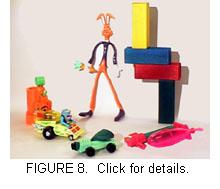 The balloon racer, water
rocket, and Rat Fink™ Hydro Racer™ shown in Figure 8 can
all be used to discuss conservation of momentum. The Hydro Racer is basically a horizontal
water rocket. Water is pumped into a thick rubber balloon, then allowed to rapidly squirt
out when the toy is released from the pump. The bendable bunny and building blocks in the
same figure can be used to illustrate finding the center of mass of an object. The center
of mass of the bunny can be estimated by dangling it from one arm then the other. If you
then change the position of the legs and repeat the process, the center of mass has
clearly changed. The building blocks are called Radical Blocks™ and can be
used to build things that seem impossible because their center of mass does not appear to
be over the base of support. The catch is that some of the blocks are solid, others are
hollow, and still others have off-center weights; thus, the center of mass is not where a
simple estimation puts it.
The balloon racer, water
rocket, and Rat Fink™ Hydro Racer™ shown in Figure 8 can
all be used to discuss conservation of momentum. The Hydro Racer is basically a horizontal
water rocket. Water is pumped into a thick rubber balloon, then allowed to rapidly squirt
out when the toy is released from the pump. The bendable bunny and building blocks in the
same figure can be used to illustrate finding the center of mass of an object. The center
of mass of the bunny can be estimated by dangling it from one arm then the other. If you
then change the position of the legs and repeat the process, the center of mass has
clearly changed. The building blocks are called Radical Blocks™ and can be
used to build things that seem impossible because their center of mass does not appear to
be over the base of support. The catch is that some of the blocks are solid, others are
hollow, and still others have off-center weights; thus, the center of mass is not where a
simple estimation puts it.
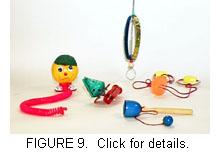 A variety of circular motion
toys are shown in Figure 9. The Christmas tree spinner, humdinger, and ribbon spinner all
show things moving outward when there is insufficient centripetal force to cause them to
move in a circle at their initial radius. The humdinger is the less familiar of the group
and is essentially a button-on-a-string folk toy with the button being made from a
stretchy polymer material. To get the ball in the cup one must cause the ball to move
initially in a circular motion then switch over to parabolic free-fall at just the right
moment. When the bungee jumper is spun in a vertical circle, the spring is stretched more
at the bottom than at the top showing that the force is larger at the bottom.
A variety of circular motion
toys are shown in Figure 9. The Christmas tree spinner, humdinger, and ribbon spinner all
show things moving outward when there is insufficient centripetal force to cause them to
move in a circle at their initial radius. The humdinger is the less familiar of the group
and is essentially a button-on-a-string folk toy with the button being made from a
stretchy polymer material. To get the ball in the cup one must cause the ball to move
initially in a circular motion then switch over to parabolic free-fall at just the right
moment. When the bungee jumper is spun in a vertical circle, the spring is stretched more
at the bottom than at the top showing that the force is larger at the bottom.
Section 6. Sound and Light Toys
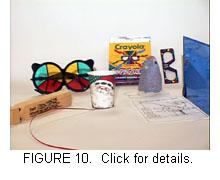 The talking cup, squawking
chicken, and train whistle shown in Figure 10 all produce sound. The cup says Merry
Christmas when one runs a thumb down the ridged plastic ribbon. This can be done with the
ribbon in and out of the cup to show the how the cup acts to make the sound louder. The
squawking chicken is a homemade version of the same toy made from a plastic drinking cup
and string. When the string is tugged with a damp cloth or sponge, a squawking noise is
heard. The train whistle, which is easily cut open, contains four resonant tubes with
lengths differing by about two centimeters.
The talking cup, squawking
chicken, and train whistle shown in Figure 10 all produce sound. The cup says Merry
Christmas when one runs a thumb down the ridged plastic ribbon. This can be done with the
ribbon in and out of the cup to show the how the cup acts to make the sound louder. The
squawking chicken is a homemade version of the same toy made from a plastic drinking cup
and string. When the string is tugged with a damp cloth or sponge, a squawking noise is
heard. The train whistle, which is easily cut open, contains four resonant tubes with
lengths differing by about two centimeters.
Also in Figure 10 are three toys relating to light. The rainbow glasses have
tri-sectioned eyepieces which can be rotated so one can look through each section in turn.
Each section is a different color filter (red, green and yellow), so one can talk about
the effect of the filter on the light passing through it. The reflect-a-sketch™
uses a piece of Plexiglas as a half-reflecting mirror. The mirror-reversed pictures, which
come with the toy, can be seen reflected in the mirror and traced. The Jumping Colors™
set contains six colored markers that can be used to make drawings that appear to be
three-dimensional when viewed with the enclosed diffraction grating glasses.
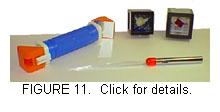 More light toys are shown in Figure 11. The periscope uses two mirrors
in the observation of an object, and it can be used to begin a discussion of ray tracing.
The mirrors in this toy can also be rotated so that the students can look at objects
behind them. The image in this case is inverted which allows for more discussion and
analysis. (4) In the Art Bank™, a small box appears to float in the bank, while
deposited coins disappear. In the Star Wars™ box, an image of Darth Vader is seen
from one angle, while Yoda is seen from a slightly different angle. Both toys use a flat
mirror to provide these illusions. The Fiber Flashlight has plastic fibers that channel
colored light along the fibers. This toy can be used to introduce the concepts of both
fiber optics and total internal reflection.
More light toys are shown in Figure 11. The periscope uses two mirrors
in the observation of an object, and it can be used to begin a discussion of ray tracing.
The mirrors in this toy can also be rotated so that the students can look at objects
behind them. The image in this case is inverted which allows for more discussion and
analysis. (4) In the Art Bank™, a small box appears to float in the bank, while
deposited coins disappear. In the Star Wars™ box, an image of Darth Vader is seen
from one angle, while Yoda is seen from a slightly different angle. Both toys use a flat
mirror to provide these illusions. The Fiber Flashlight has plastic fibers that channel
colored light along the fibers. This toy can be used to introduce the concepts of both
fiber optics and total internal reflection.
Section 7. Electrical and Magnetic Toys
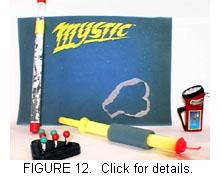 Two toys based on
electrostatic forces are included in Figure 12 along with one magnetic toy and one that
uses current electricity. The Static Stick is a very simple toy in which the outside of a
plastic tube is rubbed to create forces on bits of Styrofoam inside the tube. Using the
charged Mystic™ wand one can levitate a charged ring or other shape made
from thin Styrofoam. By measuring the mass of the ring and estimating the average distance
between the ring and wand, one can calculate an approximate charge for the ring and wand.
(5) Depending on the mathematical sophistication of the class, one could approximate the
ring and wand as two point charges, as a line of charge and a point charge, or as a line
and a ring of charge.
Two toys based on
electrostatic forces are included in Figure 12 along with one magnetic toy and one that
uses current electricity. The Static Stick is a very simple toy in which the outside of a
plastic tube is rubbed to create forces on bits of Styrofoam inside the tube. Using the
charged Mystic™ wand one can levitate a charged ring or other shape made
from thin Styrofoam. By measuring the mass of the ring and estimating the average distance
between the ring and wand, one can calculate an approximate charge for the ring and wand.
(5) Depending on the mathematical sophistication of the class, one could approximate the
ring and wand as two point charges, as a line of charge and a point charge, or as a line
and a ring of charge.
The goal of the Tri-Zany™ game is to balance six magnetic marbles on pedestals.
This is more complicated than it sounds due to the interacting magnetic fields of the
marbles. The last toy in Figure 12 is a flashlight that contains a simple electric
generator. The hand crank spins a magnet over a loop of wire that is connected to the
light bulb. The flashlight can be easily opened up to show how the various parts work
together to create the current.
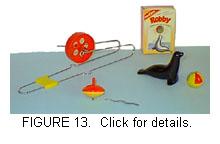 Some additional magnetic toys are shown in Figure 13. The Whee-Lo™
consists of a metal track and a magnetic wheel which sticks to the track as the wheel
rolls back and forth both over and under the track. The Snake and Top is a small metal
snake which slithers back and forth when it touches the magnetic tip of the rotating top.
Robby the magnetic seal and ball is an ingenious arrangement of magnets in the seal and in
the ball which causes the ball to rotate as the seal is brought near to it. The magnet in
the seal is oriented so that it exerts both a torque and a repulsive force on the ball.
This causes the ball to tip slightly and then rotate. The rotation continues as long as
the seal is moved toward the ball. (6)
Some additional magnetic toys are shown in Figure 13. The Whee-Lo™
consists of a metal track and a magnetic wheel which sticks to the track as the wheel
rolls back and forth both over and under the track. The Snake and Top is a small metal
snake which slithers back and forth when it touches the magnetic tip of the rotating top.
Robby the magnetic seal and ball is an ingenious arrangement of magnets in the seal and in
the ball which causes the ball to rotate as the seal is brought near to it. The magnet in
the seal is oriented so that it exerts both a torque and a repulsive force on the ball.
This causes the ball to tip slightly and then rotate. The rotation continues as long as
the seal is moved toward the ball. (6)
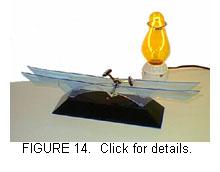 A Wild Flicker Light and a Space Wheel are shown in Figure 14. The
Flicker Light has a long filament which carries an alternating current when it is plugged
into an AC source. A magnet near the top of the bulb causes the filament to vibrate,
demonstrating the magnetic force on a current carrying wire. When the magnetic force is
large enough, the filament vibrates in a crazy fashion, apparently demonstrating chaotic
motion, so this novel lamp can be used to introduce the concept of chaos. The Space Wheel
is a toy which rolls back and forth forever (or until the battery wears out). While it is
not an example of perpetual motion as some students might believe, it is an excellent
demonstration of the laws of electromagnetism (Faraday's Law, Lenz's Law, and Ampere's
Law). The rotating wheel contains a magnet that induces a voltage in a coil in the base of
the toy which turns on a circuit containing a battery and a second coil. The induced
voltage in the first coil opposes the motion of the rolling magnet. The second coil is
wound in the opposite direction from the first, so that the current in it produces a
magnetic field that aids the motion of the wheel, and keeps it moving almost indefinitely.
(4)
A Wild Flicker Light and a Space Wheel are shown in Figure 14. The
Flicker Light has a long filament which carries an alternating current when it is plugged
into an AC source. A magnet near the top of the bulb causes the filament to vibrate,
demonstrating the magnetic force on a current carrying wire. When the magnetic force is
large enough, the filament vibrates in a crazy fashion, apparently demonstrating chaotic
motion, so this novel lamp can be used to introduce the concept of chaos. The Space Wheel
is a toy which rolls back and forth forever (or until the battery wears out). While it is
not an example of perpetual motion as some students might believe, it is an excellent
demonstration of the laws of electromagnetism (Faraday's Law, Lenz's Law, and Ampere's
Law). The rotating wheel contains a magnet that induces a voltage in a coil in the base of
the toy which turns on a circuit containing a battery and a second coil. The induced
voltage in the first coil opposes the motion of the rolling magnet. The second coil is
wound in the opposite direction from the first, so that the current in it produces a
magnetic field that aids the motion of the wheel, and keeps it moving almost indefinitely.
(4)
Section 8. Quantitative Toys
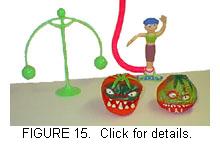 A variety of toys have been found to be suitable for detailed
quantitative measurements. Shown in Figure 15 are the Balancing Circus Man and the Bungee
Jumper® with his Killer Tomatoes. The Balancing Circus Man can be used to
discuss center-of-mass and stable equilibrium. But, in addition, if it is tipped slightly
and released, it can be used to examine oscillations about its equilibrium position. The
period of these oscillations can be predicted by calculating the moment of inertia of the
toy about various axes. The toy can be assumed to be made up of a variety of pieces (e.g.,
spheres, thin rods, etc.), and these are just the shapes which are often considered when
discussing moments of inertia in a college physics class. The predicted periods of
oscillation for different axes were found to give excellent agreement with the measured
values. (7) The Bungee Jumper is a toy man on a plastic spring which can be dropped and
observed to bounce in the manner of a real bungee jumper. The properties of the spring can
be examined by hanging weights on the man and measuring the amount of stretch of the
spring. The weights which were used were Killer Tomatoes (which are rather more fun than
using traditional metal masses). When a graph of distance versus weight was plotted, a
straight line was obtained showing that the spring did obey Hooke's Law, and it had a
spring constant of 1.3 N/m. These toys can also be observed in action on the web at
http://www.clemson.edu/phys-car.
A variety of toys have been found to be suitable for detailed
quantitative measurements. Shown in Figure 15 are the Balancing Circus Man and the Bungee
Jumper® with his Killer Tomatoes. The Balancing Circus Man can be used to
discuss center-of-mass and stable equilibrium. But, in addition, if it is tipped slightly
and released, it can be used to examine oscillations about its equilibrium position. The
period of these oscillations can be predicted by calculating the moment of inertia of the
toy about various axes. The toy can be assumed to be made up of a variety of pieces (e.g.,
spheres, thin rods, etc.), and these are just the shapes which are often considered when
discussing moments of inertia in a college physics class. The predicted periods of
oscillation for different axes were found to give excellent agreement with the measured
values. (7) The Bungee Jumper is a toy man on a plastic spring which can be dropped and
observed to bounce in the manner of a real bungee jumper. The properties of the spring can
be examined by hanging weights on the man and measuring the amount of stretch of the
spring. The weights which were used were Killer Tomatoes (which are rather more fun than
using traditional metal masses). When a graph of distance versus weight was plotted, a
straight line was obtained showing that the spring did obey Hooke's Law, and it had a
spring constant of 1.3 N/m. These toys can also be observed in action on the web at
http://www.clemson.edu/phys-car.
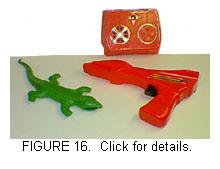 Shown in Figure 16 are a Magic Animal and an Infrared Blaster®.
The Magic Animal is a small plastic alligator which when placed in water grows
considerably in size. Its mass increases by a factor of about 30, and its length by a
factor of three. This toy can be used in elementary grades to teach the concepts of
measurement of length and mass. It can later be used to introduce the concepts of
graphing, with bar graphs and line graphs. For high school and college classes it can be
used to study exponential growth, semi-log graphs, and curve fitting. The Infrared Blaster
is a toy consisting of a gun that shoots an invisible beam and a target that detects the
beam. This toy is an excellent one to illustrate the investigation of an unknown. The
properties of this "unknown" beam can be measured and compared, for example, to
the properties of light. The beam is observed to reflect from mirrors and metal sheets.
When the angle of incidence and the angle of refraction of the beam are measured, the beam
is found to obey the Law of Reflection. The beam was also sent through a semicircular
Plexiglas lens. Again, the angle of incidence and the angle of refraction were measured,
and the beam was found to obey Snell's Law with an index of refraction of about 1.4.
Finally, the beam was observed to diffract when sent through a diffraction grating, and
its wavelength was measured to be about 920 nm. The conclusion that can be reached is that
the beam is indeed an electromagnetic wave and is, in fact, infrared light (which is no
great surprise, given the name of the toy). (4)
Shown in Figure 16 are a Magic Animal and an Infrared Blaster®.
The Magic Animal is a small plastic alligator which when placed in water grows
considerably in size. Its mass increases by a factor of about 30, and its length by a
factor of three. This toy can be used in elementary grades to teach the concepts of
measurement of length and mass. It can later be used to introduce the concepts of
graphing, with bar graphs and line graphs. For high school and college classes it can be
used to study exponential growth, semi-log graphs, and curve fitting. The Infrared Blaster
is a toy consisting of a gun that shoots an invisible beam and a target that detects the
beam. This toy is an excellent one to illustrate the investigation of an unknown. The
properties of this "unknown" beam can be measured and compared, for example, to
the properties of light. The beam is observed to reflect from mirrors and metal sheets.
When the angle of incidence and the angle of refraction of the beam are measured, the beam
is found to obey the Law of Reflection. The beam was also sent through a semicircular
Plexiglas lens. Again, the angle of incidence and the angle of refraction were measured,
and the beam was found to obey Snell's Law with an index of refraction of about 1.4.
Finally, the beam was observed to diffract when sent through a diffraction grating, and
its wavelength was measured to be about 920 nm. The conclusion that can be reached is that
the beam is indeed an electromagnetic wave and is, in fact, infrared light (which is no
great surprise, given the name of the toy). (4)
Section 9. Experiments with Toys
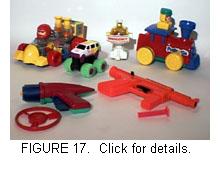 In addition to observing
many toys and ideas, the workshop participants were also given the opportunity to perform
experiments with the toys. The participants were divided into groups of 3 or 4, and each
group was given a toy and asked to devise and carry out an experiment with their toy. Some
of the toys used for these experiments are shown in Figure 17. The dart gun was fired
horizontally from various heights to see how initial position affected range. The
pull-back robot, See-Thru-Racer and explorer gun were all used in experiments that looked
at how the amount they were wound affected the distance traveled. Sample results from the
latter two experiments can be found in Ref. 2. The electric car was used to produce data
for a distance versus time graph. One group investigated the ability of the Push-N-Go®
to climb shallow inclines. (8) Another group investigated how the amount of air in the
balloon racer, shown in Figure 8, affected the distance traveled. While the time to do
these experiments was limited, the groups were all able to obtain some results which were
then shared with all of the participants. These experiments demonstrated both how toys can
be used in quantitative investigations and some of the difficulties involved in doing
this.
In addition to observing
many toys and ideas, the workshop participants were also given the opportunity to perform
experiments with the toys. The participants were divided into groups of 3 or 4, and each
group was given a toy and asked to devise and carry out an experiment with their toy. Some
of the toys used for these experiments are shown in Figure 17. The dart gun was fired
horizontally from various heights to see how initial position affected range. The
pull-back robot, See-Thru-Racer and explorer gun were all used in experiments that looked
at how the amount they were wound affected the distance traveled. Sample results from the
latter two experiments can be found in Ref. 2. The electric car was used to produce data
for a distance versus time graph. One group investigated the ability of the Push-N-Go®
to climb shallow inclines. (8) Another group investigated how the amount of air in the
balloon racer, shown in Figure 8, affected the distance traveled. While the time to do
these experiments was limited, the groups were all able to obtain some results which were
then shared with all of the participants. These experiments demonstrated both how toys can
be used in quantitative investigations and some of the difficulties involved in doing
this.
Summary
The workshop participants were introduced to a large number of toys which can be used
to demonstrate principles of physics. They had an opportunity to be involved in both
qualitative and quantitative investigations of the toys. In addition to receiving several
toys to take with them to their classrooms, the participants carried away many ideas about
how toys can be used in the classroom to make physics less threatening and more enjoyable
to their students. Physics can be fun not only for students, but also for the teachers. By
using toys, physics can be fun for everyone.
References
- Turner, R., The Physics Teacher, 30, 542-543, 1992.
- Taylor, B. A. P., Exploring Energy with Toys: Complete Lessons for Grades 4-8,
New York, McGraw-Hill, pp. 59-75, 1998.
- Turner, R.C., American Journal of Physics, 51, 475-476, 1983.
- Halliday, D., R. Resnick, J. Walker, Fundamentals of Physics, Fourth Edition, New
York, Wiley, 1993, Essay 11, pp.1-3.
- Taylor, B. A. P., The Science Teacher, 56, 37-39, 1989.
- Turner, R.C., The Physics Teacher, 25, 568-569, 1987.
- Turner, R.C., American Journal of Physics, 55, 84-85, 1987.
- Taylor, B. A. P., Science Scope, 21, 28-31, 1998.