- a. copper, neutral
- b. amber, negative
- c. amber, neutral
- d. amber positive
- e. glass, negative
- f. glass, not enough information to solve
13. Which of the following objects is attracted by a negatively charged rod?
- a. only other negatively charged objects.
- b. only positively charged objects.
- c. both positively charged and neutral objects.
- d. only neutral objects.
- e. Not enough information to predict correctly.
14. Two identical electroscopes, one initially charged and the other uncharged, are
connected by a thin rod. If the foils on the electroscopes do not move, we can say that
the connecting rod is
- a. a conductor.
- b. an insulator.
- c. a semiconductor.
- d. of the same, but opposite charge.
15. Suppose that you find an electroscope with separated foils. When you bring a
positively charged rod near the electroscope, the foils move closer together. You can
conclude that the electroscope is
- a. uncharged.
- b. positively charged.
- c. negatively charged.
- d. It is impossible to tell from such limited information.
16. Two charged objects are very, very far away from any other charges. If the distance
between the charges is halved, the force between the charges
- a. doubles.
- b. gets reflected.
- c. quadruples.
- d. becomes one one-fourth as large.
- e. is reversed in direction.
- f. None of the above.
17. The electric force on a positive charge located near an isolated positive charge
- a. points away from the isolated charge.
- b. points toward the isolated charge.
- c. is tangent to a circle centered on the isolated charge.
- d. is zero.
- e. None of the above.
18. The electric charge on an electron _____ that on a proton.
- a. is identical to.
- b. is smaller than (since the electron is less massive)
- c. is the same size, but opposite in sign to
- d. is larger than
- e. None of the above.
19. Even though the electrical force is very much stronger than the gravitational
force, gravity determines the motion of the heavens because
- a. gravity sucks - i.e. it attracts all other masses.
- b. the electrical forces have a longer range than gravity.
- c. most objects are approximately electrically neutral.
- d. (a) and (c) above.
- e. None of the above.
20. The force that holds an atom together is
- a. understood only by Buddhist monks.
- b. well studied by chemists, but unknown to physicists.
- c. magnetic.
- d. nuclear.
- e. electrical.
- f. super-glue.
- g. none of the above.
21. The lines of force drawn for an electric charge
- a. point away from positive charges and toward negative charges.
- b. point away from negative charges and toward positive charges.
- c. never cross
- d. (a) and (c) above are both true.
- e. (b) and (c) above are both true.
22. What is the size of the electric force between a 3 C charge and a 4 C charge that
are separated by 5 m?
- a. k (3 C + 4 C) / (5 m)
- b. k (3 C) (4 C) / (5 m)
- c. k (3 C) (4 C) / (5 m)2
- d. k (3 C + 4 C) / (5 m)2
- e. None of the above.
24. Explain how an object (such as an electroscope) can be charged by induction.
26. What is the necessary condition for constructive interference to occur between two
coherent waves (in two or three dimensions).
27. The superposition principle is a very powerful concept. Briefly discuss this idea,
giving especial attention to the usefulness in predicting how wave interfere.
29. Explain HOW the balloon was made to stick to the wall during the demonstration.
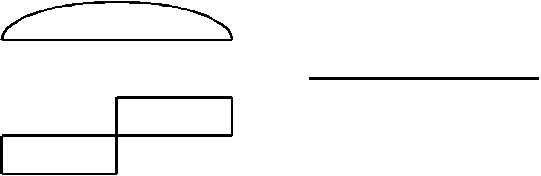
31. Sketch the wave that results from the two waves shown in the figures below
interfering with each other.
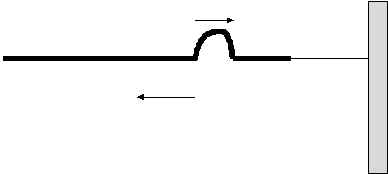
32. Sketch the reflection of the pulse wave for the case shown below. (2 points)
1. A gas can be identified by means of its spectral lines because each
element
- a can be recognized when magnified greatly
- b occupies a unique position in the periodic table
- c emits characteristic wavelengths when electrically excited
- d has a different atomic number
- e none of the above
2. Cathode rays are
- a negatively charged
- b electrons
- c pieces of atoms
- d All of the above
- e none of the above
3. In his famous oil drop experiment, Millikan discovered that
- a not all electrons are the same.
- b cathode rays are electromagnetic waves
- c electrical charge comes in identical "chunks" or "quanta"
- d cathode rays are electrons
- e none of the above
4. What force is responsible for holding the electrons in their orbits
about nuclei?
- a gravitational
- b electric
- c magnetic
- d no force is required
- e none of the above
5. Rutherford’s model of the atom as a very tiny, massive nucleus with the
electrons orbiting could NOT explain why
- a most alpha particles pass right through a thin gold foil
- b some alpha particles are deflected at large angles, even backwards
- c atoms emit a special set of discrete wavelengths.
- d a) and c) above
- e none of the above
6. As the temperature of a radiating object increases, the wavelength with the
maximum intensity
- a increases
- b stays the same
- c decreases
- d is 632.8 nm exactly
- e none of the above
7. According to Planck, the energy of a quanta can be calculated by
- a E = h l
- b E = h / l
- c E = h f
- d E = h / f
- e none of the above
8. Photoelectrons are emitted from a metallic surface only when the incident
light has more than a certain minimum
- a speed
- b wavelength
- c frequency
- d intensity
- e none of the above
9. A clean surface of potassium metal will emit electrons when exposed to blue
light. If the intensity of the blue light is increased, the _________ of the ejected
electrons will also increase.
- a mass
- b average speed
- c number
- d maximum kinetic energy
- e none of the above
10. Bohr gave the following reason for the electrons in the hydrogen atom
existing only in certain discrete energy levels
- a this agrees with Newtonian mechanics
- b this agrees with Maxwell’s equations (classical electromagnetic theory)
- c he just postulated it
- d a) and b) above
- e none of the above
11. Which of the following is quantized in the Bohr atom?
- a radius
- b energy
- c angular momentum
- d All of the above
- e none of the above
12. An electron in the ground state (n=1) of the Bohr atom has a radius of 0.053
nm. What is the radius of the next larger orbit?
- a 0.053 nm
- b 0.106 nm
- c 0.159 nm
- d 0.212 nm
- e none of the above
13. Two hydrogen atoms have electrons in the n = 3 energy level. The first
electron jumps to the n = 2 level and the other jumps to the n = 1 level. Which
property is larger for the first photon? Note:
this problem requires significant thought
- a velocity
- b frequency
- c wavelength
- d energy
- e none of the above
14. Bohr could never explain why an electron was limited to certain
orbits. De Broglie explained this by showing that electrons
- a form standing wave patterns about the nucleus
- b have elliptical orbits like the planets around the sun
- c occupy a continuum of orbits by only radiate from some
- d obey Maxwell’s equations
- e none of the above
15. The wave behavior of bowling balls is not observed because
- a their speeds are too small
- b their momenta are too small
- c wave properties only occur on the atomic scale
- d their wavelengths are too small to be observed
- e none of the above
16. If the two-slit experiment is performed with a beam of electrons so weak
that only one electron passes through the apparatus at a time, what kind of pattern would
you expect to obtain on the viewing screen (after a long period of time)?
- a one hump
- b two humps showing no interference
- c an interference pattern
- d the sum of the patterns formed when each slit is open by itself
- e none of the above
17. If an electron is confined to a box and it has the lowest possible energy,
where would you most likely find the electron?
- a in the center
- b near an edge
- c any place
- d midway between the center and the edge
- e none of the above
18. According to Heisenberg’s uncertainty principle, it is impossible to
precisely determine an object’s position and its _______ at the same time.
- a energy
- b momentum (along the same direction)
- c angular momentum
- d spin
- e none of the above
19. If you could determine which slit the electron goes through, what effect
would it have on the two-slit interference pattern?
- a it would have no effect.
- b it would reduce the overall intensity of the pattern
- c it would destroy the interference pattern
- d it would start a chain reaction
- e none of the above
20. If radium (which is radioactive) and chlorine (which is not radioactive)
combine to form radium chloride, the compound is
- a no longer radioactive
- b radioactive to the same extent as the radium content
- c half as radioactive
- d as radioactive as the mass number of chlorine divided by the atomic number of
radium
- e none of the above
21. Three of the names below refer to the same thing. Which name does NOT?
- a beta particles
- b cathode rays
- c alpha particles
- d electrons
- e none of the above
22. The atomic mass of a nucleus is approximately given by the number of its
- a neutrons
- b nucleons
- c protons
- d electrons
- e none of the above
23. Atoms whose nuclei contain the same number of protons but different number
of neutrons are called
- a radioactive
- b isotopes
- c nucleons
- d pair products
- e none of the above
24. What is the daughter formed when 146C decays by beta
decay?
a 188O
b 104Be
c 157N
d 147N
e none of the above
25. If a nucleus decays by emitting an alpha particle, the daughter has
- a one less charge and almost no change in mass
- b one more charge and almost no change in mass
- c two less charges and about 4 AMU less mass
- d two more charges and about 4 AMU more mass
- e none of the above
26. A radioactive material has a half-life of 2 minutes. If you begin with
512,000 radioactive nuclei, approximately how many would you expect to have after 4
minutes?
- a 256,000
- b 128,000
- c 64,000
- d 32,000
- e 16,000
- f zero!
- g none of the above is correct.
27. Which of the following is a unit that reflects the biological effect caused
by radiation?
- a rad
- b REM
- c joule
- d curie
- e none of the above
28. Which of the forces is responsible for holding the nucleons together to form
the nucleus?
- a strong
- b weak
- c gravitational
- d electrical
- e none of the above
30. Briefly discuss the phenomena of blackbody radiation OR the
photoelectric effect. Describe the phenomena, how classical physics failed, and how
quantum physics provided an explanation. (6 pts)
31. In Quantum Mechanics, massive particles are represented as waves (at least
mathematically).
, related to the probability of finding a particle at a given location? (4
pts)
32. Assume that you have two nuclei that have a half-life of 10 minutes. One has
just been created as the daughter of a decay, while the other has already been in
existence for 19 minutes. Which is more likely to decay in the next minute? Justify your
answer! (4 pts)
33. Why did some philosophers find the Heisenberg Uncertainty Principle
very disturbing? ( 6 pts)
34. You are given 3 radioactive cookies: one emits alpha, one beta and the
third gamma. You must eat one, hold one and put one in your pocket. Explain what ( and
why) you would do with each cookie to minimize harm to yourself. (6 pts)
35. For a given metal, the spectrum of intensity versus wavelength for x-rays
can be loosely described as a blunt nosed whale, facing left, that has spikes on its back.
Explain how each part of this spectrum arises. (6 pts)
36. Discuss the dual nature of the quantum physical world. Sometimes a wave
description is appropriate and other times it is not. How does nature cope with the dual
aspects of its most elementary inhabitants? (6 points)
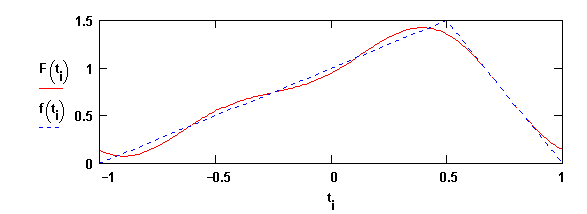
38. Refer to the figure above. a) Where would you expect to be the
most likely location of ‘finding’ the particle? Why?
b) Where would you think is the least likely position for finding the
particle? Why?