Practice Exam II
Complete the following questions as indicated. Clarity is extremely important.
1. What facts would you need in order to calculate the acceleration due to gravity on Mars?
2. State Newton's First Law in terms of the motion of an object.
3. I push on a piano with a force of 50 N, but the piano doesn't move. The mass of the piano is 250 kg and the coefficient of static friction is 0.1. What is the static friction force on the piano while I am pushing on it.
4. A book is resting on a table. The normal force of the table exactly cancels the weight-force of the earth's gravity. Do these two forces constitute an action-reaction pair? Explain. (4 points).
5. A large truck collides head-on with a small car. Is the force the truck exerts on the car larger than, smaller than, or equal to the force the car exerts on the truck? Explain.
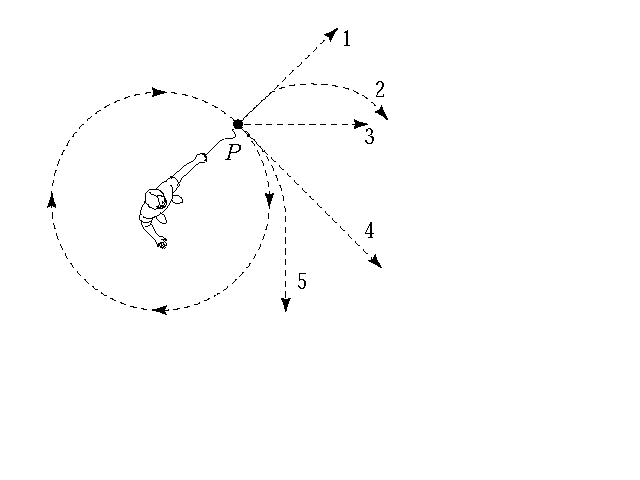
6. A steel ball is attached to a string and is swung in a circular path in a horizontal plane as illustrated in the figure. At point P, the string suddenly breaks near the ball. If these events are observed from directly above, which of the paths 1-5 would the ball most closely follow after the string breaks? Justify your answer. (4 points)
7. You are riding on a bus standing up in the aisle. The driver suddently slams on the breaks to avoid an accident. Why do you fall forward?
Problems: Complete each of the following as indicated.
a) Draw a freebody diagram for the car while it is on the sloped driveway.
b) What is the car's acceleration while going down the driveway?
c) What is the speed of the car at the bottom of the driveway?
d) How far does the car travel before stopping?
3. The proton has a mass of 1.66x10⁻²⁷ kg. The electron has a mass of 9.11x10⁻³¹ kg. In the hydrogen atom, the gravitational force of attraction between the two is 3.6x10-47 Nt. What is the separation between the electron and proton in the hydrogen atom? What is the electrical force between them?
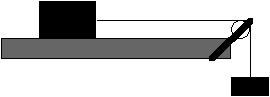
4. A 20 kg mass rests on a frictionless horizontal table. At the edge of the table is a pulley. A string joins the 20 kg mass to a hanging 5 kg mass as shown in the diagram. The string and pulley may be considered to be ideal - i.e. massless and frictionless.
- a) Draw a Free Body Diagram for each mass.
- b) Apply Newton's 2nd law to each mass and determine the tension in the string and the acceleration of the 20 kg mass.
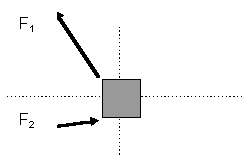
5. A 5 kg crate is acted upon by two forces as shown in the diagram.
a) Find the acceleration of the crate – magnitude and direction. The view is a top view, and you may assume the crate is resting on a level frictionless floor.
6. The crate of the previous problem moves 7m North. How much work is
done on the crate by forces F1 and F2? If the motion
takes 3 s, what is the average power applied by F1?
A sphere of moment of inertia 0.4 kg m2 has an angular velocity of 30 rad/s when a torque is applied for 4.2 s. The result is a final angular velocity of 57 rad/s. What was the value of the torque?
An old phonograph can accelerate from rest to 33.3 rev/min in 3.5 s. What is its average angular acceleration in rad/s2?
A 3kg mass is whirled in a horizontal circle of radius 3.2 m at a constant speed of 8 m/s using a string. Determine the angular velocity of the mass and the force exerted by the string.
A system consists of three particles: 3kg at (0,0), 1 kg at (4m, 0) and 6 kg at (4m, -3m). (a) Find the center of mass of the system.