Practice test for Exam 1
1. Convert 9.80 m/s2 into inches/hour2. Hint: (2.54 cm = 1 in)
2. Two identical cars are in a drag race. The first starts at t = 0 and continues to the end of the race with a constant acceleration. The second starts at t = 1, and continues with the same acceleration as the first car. Will the cars be the same distance apart throughout the race? Justify your answer. How much time will there be between the two successive crossings of the finish line?
3. A 600 km cross-country bicycle race is won by a team of two riders, each of whom had the wheel for part of the trip. If one averaged 50 km/h for 5 hours, and the team average for the race was 45 km/h, what was the average speed of the other rider?
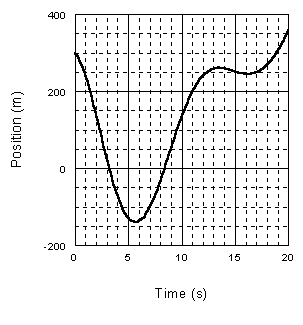
Questions/problems 4- 7 on this page refers to the graph at the right.
4. Determine the approximate velocity at t = 3 seconds:
5. Determine the average velocity during the first 10 seconds of motion and during the last 10 seconds of motion.
6. a) What is the total distance traveled between t = 0 and t = 3 sec? Explain.
b) What is the displacement between t = 0 and t = 5 sec? Explain.
7. List the time intervals for which the velocity is positive ( use the form ___ s to ___s, where you put the appropriate numbers in the blanks).
8. A strange green object experiences a constant acceleration. During this period its velocity changes from -4 to 26 m/s, and the object travels a distance of 175 m. How long did the object undergo acceleration? What is the acceleration?
9. Vectors A and B are shown in the picture below. a) Carefully draw a sketch to show how you would add these vectors graphically. You do not need to take time to measure lengths and angles. b) Calculate the components of each vector. Enter your results in the spaces provided.
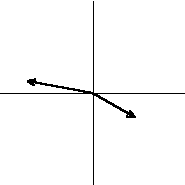
A = 12 km @ 170° B = 9 km @ -30°
Ax = _______ Ay = ________ Bx = _______ By = ________
10. Calculate the sum of the two vectors in Problem 9 (magnitude and direction).
11. It is a relatively common mistake to think that the acceleration of a golf ball is zero when the ball has been tossed up and is at its highest point. Why is this a mistake? What would be the repercussions if this were true?
12. What is the fundamental unit of time? How is it defined?
13. The velocity of an object with non-constant acceleration is given by: v(t) = t2 - 10t + 9. Calculate the average acceleration between t=1 and t=9 seconds. Assume the units to be SI.
14. A top fuel dragster can travel a distance of 0.250 miles (402 m) in 5.8 seconds (starting from rest). What is the acceleration of the dragster (assumed to be constant) for the trip.
15. A train is traveling east at a speed of 3.4 m/s. Using a compass for direction, a man on a flat car of the train walks 20 degrees west of north at a speed of 1.2 m/s relative to the flatcar. What is the man's velocity relative to the ground?
16. A ball rolls along a level table, out a window and hits the ground 27 m beyond the window 2.5 seconds after going out the window. What was the balls velocity when it was on the table? How high is the table above the ground? (added by Barney, since was on exam 2 last time).