Practice Test for Exam II
1. The attractive electrical force between two charges placed 5.5 m apart has a magnitude of 24 Nt. If one of the charges is 0.020 C, determine the other charge.
2. A 30 nF capacitor carries opposite charges of 1500 nC on each plate. What is the potential difference and the electric field between the two plates? What if they are both +1500 nC?
3. a) Explain why the potential inside a solid conducting sphere with charge Q is a constant. b) Explain why the electric field at the surface of a conductor is perpendicular to the surface.
4. A parallel-plate capacitor is connected to a battery and allowed to charge. The battery is first removed and a slab of glass is inserted between its plates. What happens to the capacitance, charge and potential difference?
5. A point charge is located at the point (x = -4.0 m, y = 0 m). The electric field at the point (x = 2 m, y = 0 m) has a magnitude of 5000 N/C and is directed in the minus x-direction.
a) What is size and sign of the charge described above?
b) Assuming a +3 nC charge is placed at (x = 2 m, y = 0 m), what force will it experience due to the charge described in problem 1? Remember to give both magnitude and direction.
6. A glass rod is brought up near an object with no net charge. The object becomes polarized with positive charge nearest the glass rod. Is the glass rod neutral (no net charge), positively charged or negatively charged? Does a force exist between the glass rod and object? If so is it attractive or repulsive.
7. Two positive charges are a distance r from each other. If the distance is tripled, what happens to the magnitude of the force?
8. A dipole with +2 C and -2 C separated by 1 mm is placed in a uniform field with the dipole axis (line connecting the charges) parallel to the field lines. What is the torque on the dipole?
9. Assume that two charges, Q1 = +5 nC, located at (x = 0 m, y = -3 m), and Q2 = -5 nC, located at (x = 0 m, y = 5 m), lie along the y-axis.
a) Are there any locations on the y-axis (other than at infinity) where the electric field is zero? Make a sketch showing the contribution to the electric field due to each charge. If such a point exists, solve for its location. If it does not exist, explain why the point cannot exist. (6 points)
b) Calculate the electric potential due to the two charges at the point (x = 2 m, y = 1 m). Assume that the potential is zero at infinity.
c) How much charge would have to be placed at (x = 2 m, y = 1 m) to have an electric potential energy of 1.00 J? (under the conditions of the previous two problems)
d) If this charge were allowed to move how fast would it be going when it got to the point (x = 2 m, y = 5 m)
10. Discuss the process of polarization of an insulator by "free" charges. How is this related to the ability of a charged balloon to cling to an uncharged, insulating wall?
11. A +2 C point charge moves from x = 2 cm to x = 6 cm in a region of uniform electric field E = 10 N/C pointing in the positive x direction. What is the change in electric potential?
12. 5 wires come together at a junction. Two wires have current flowing into the junction (5 A and 12 A). One wire has 7 A flowing out of the junction. The fourth wire has a 2 ohm resistor connected to a region where the potential is 0 V and the junction is at 4 V. What is the current in the 5th wire?
13. Eight Coulombs flow through a 2 ohm resistor in 4 seconds. What is the potential difference across the resistor
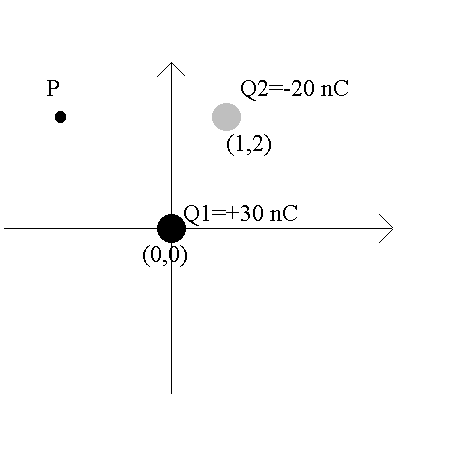
14. Two charges are located as shown in the following diagram. Determine the electric field at the point, P, [located at (-2, 2)] due to the two charges (both magnitude and direction).
15. A wire made of nichrome (resistivity = 1.5 x 10⁻⁶ W-m) 20 m long with cross section 2 x 10⁻⁶ m2 is used in a heater. What is the resistance?
16. Discuss how non-ohmic materials differ from ohmic materials. Discuss how they both differ from superconductors.
17. A capacitor is constructed by placing 2 metal plates (4 meters by 2 meters) parallel to each other separated by 50 centimeters with a dielectric medium (K = 2) inside. Initially, a 1 A current flows through a 15 ohm resistor placed across the plates. What is the total energy stored on the capacitor?
18. An electron is accelerated in a vacuum between two metal plates with an electric potential difference of 15 V. What is the final speed of the electron (me = 9.11 x 10⁻³¹ kg)?
19. A heater produces 1 kW when the potential difference across it is 120 V. What is the current? After heating up is produces 2 kW of heat and radiation. What has changed and by how much?
20. If I double the current through a resistor how much does the power dissipated change?