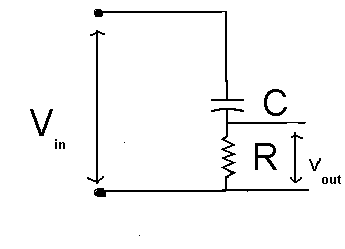
 Capacitive High Pass
Filter
Capacitive High Pass
FilterFilters and Resonant Circuits
Last week you observed the effect that capacitors have on the current in a circuit that was essentially a switched DC circuit. Today you will extend your observations to AC circuits and look at the effects of inductors as well.
In a DC circuit, there is only current until the capacitor is fully charged. However, in an AC circuit of high enough frequency the capacitor never has time to get fully charged before the voltage reverses causing the capacitor to discharge. Thus, there is always current in the circuit. An inductor has little effect other than adding resistance to a DC circuit because it is basically just a long piece of wire. However, the rapidly changing currents of AC set up magnetic fields which, according to Faraday's Law, lead to induced emf in the coil which always opposes the original current change. The more rapidly the current changes (high frequency AC) the greater will be the induced opposition.
These frequency-dependent effects of inductor and capacitors can be useful in a variety of ways. One is separating high frequency signals from low frequency ones. This might be useful, for example, if you wanted to get rid of a 60-Hz hum in your radio. You could use a capacitor or inductor in series with a resistor as shown below. Consider the RC circuit (top picture). If the input voltage voltage has a high frequency, then the capacitor never has a chance to develop much charge and its voltage will be low. Thus, the voltage across the resistor will be almost equal to the input voltage. On the other hand, if the frequency is small, the switching happens slowly, so that most of the time the capacitor is fully charged. Then I = 0 and so the voltage across the resistor. Thus, you measure a significant output voltage for high frequencies. You should think through the other three cases for yourself. (Hint: this sounds like a lab quiz question).
Capacitive High Pass
Filter
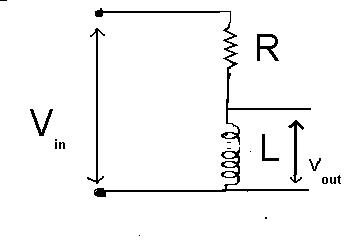 Inductive High Pass Filter
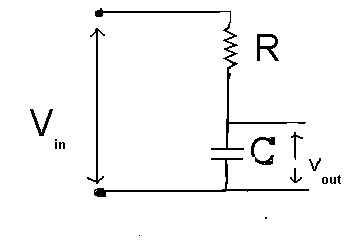 Capacitive Low Pass Filter
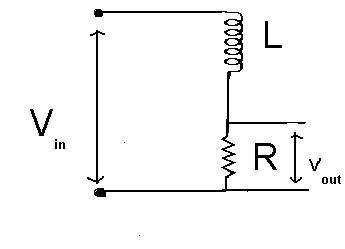 Inductive Low Pass Filter
By combining a capacitive high pass filter in series with an inductive low pass filter, you can make a resonant circuit, which selects a small range of frequencies to pass, while blocking all higher and lower ones. Such circuits are used for tuning a radio to a particular station.
Part I. Set up the circuit shown below with R = 4700 ohms and C = 0.01 microfarad.
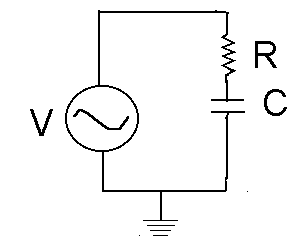
Use your oscilloscope to monitor the voltage across the generator (input voltage) and the voltage across the capacitor (output voltage). Set the input voltage at 2 volts, peak to peak. As you change the frequency you may have to adjust the amplitude on the generator in order to maintain 2 volts. Measure the output voltage at each of the following frequencies: 20 hz, 50 hz, 100 hz, 200 hz, 500 hz, 1000hz, 2 khz, 5 khz, 10 khz, 20 khz, 50 khz, and 100 khz. Compute the ratio of Vout/Vin. Plot this ratio as a function of frequency. Plot a second graph using log f instead of f. Based on your graphs, what can you conclude about the characteristics of this circuit.
Part II. Set up the circuit shown below with R = 1000 ohms, C = 0.1 microfarad and L = 25 millihenry.
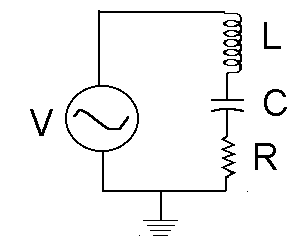
Using the same input voltage and frequencies as in Part I, measure the voltage across the resistor. Compute Vout/Vin and plot the voltage ratio versus the log of the frequency. Once you have identified the peak output frequency take some more data near this frequency trying to locate the frequency which gives you the maximum output. This frequency is called the resonant frequency of the circuit. Calculate the theoretical resonant frequency for your circuit and compare it to your experimental value.
Part III.
Replace the 1000 ohm resistor with a 47 ohm resistor. Use a 2v square wave at approximately 250 hz as the input. Look at Vout on the oscilloscope. Describe what is happening in the circuit. Measure the frequency of the oscillation.