SIMPLE CIRCUITS
Throughout this lab, keep the circuit closed only long enough to, observe the necessary data. Measure the resistance of your three resistors using the digital meter. Decide which is to be RI, R2 and R3, and then use them as such throughout the lab.
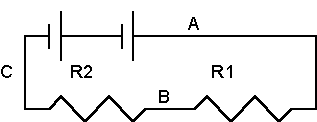
Connect the circuit shown below. Measure the current at the points labeled A, B, and C. How would you expect the three values to compare? Explain. Measure the potential difference across each resistor and then the potential across the two resistors together. Calculate the percentage difference between the sum of the individual voltage drops and that of the total. Show from the data. that the voltage is directly proportional to the resistance, when the current is constant. (Compare V1 / V2 to R1/R2)
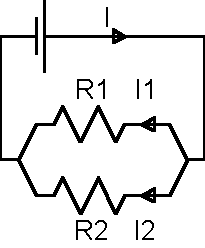
Connect the circuit shown, below. Measure the currents I, I1 and I2. Compare the total current, I, with the sum of I1 and I2. Show from the observed data that the two currents vary inversely with the corresponding resistances. Measure the voltage across the battery and then measure the voltage across each resistor. How do these compare?
Connect the circuit shown below. Measure the potential difference between points A and C. Using the voltage across A-C and the resistances R1, R2, and R3, calculate the current in each resistor. Then measure the three current values. Compare your calculated and experimental results.
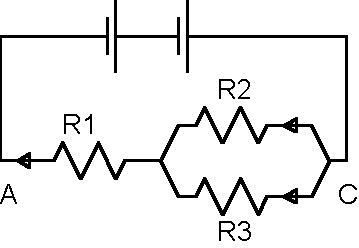
Connect the circuit shown below. Measure the potential difference between the points A-B and B-C. Apply Kirchoff’s laws to the circuit and write the number of independent current and voltage equations necessary to solve for the unknown current in each branch. Solve the equations for these currents. Having calculated the current in each measure the respective currents experimentally. Compare your calculated and measured values. How well do they compare?
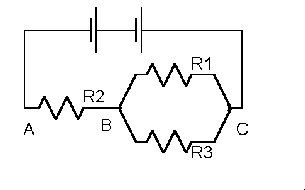
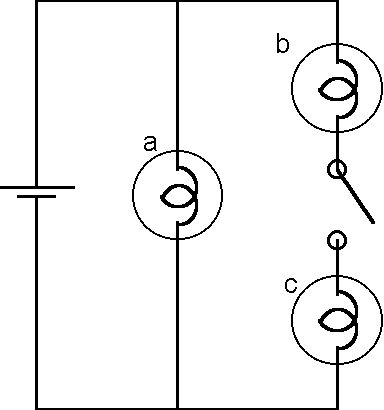
Using what you have now learned about series and parallel combinations of resistances predict the relative brightness of each of the bulbs in the circuit below. Assume all of the bulbs are identical. Explain your reasoning. Set up the circuit to check your predictions.
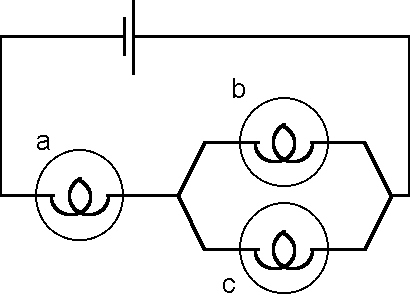
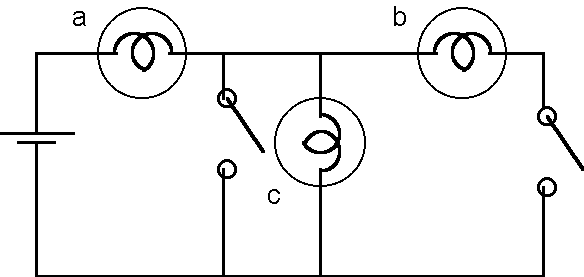
For each of the circuits below, predict the brightness of each bulb, with the switches open, as shown. Then predict how each bulb will change in brightness when the switch is closed. Support your answers with explanations. Set up the circuit and check your predictions.